Custom Web Development vs. Standard CMS: Making the Right Decision
The right answer depends on your growth trajectory, not which option sounds more impressive
Nexovah Staff
27d ago · 10 min read
Key Takeaways
- Custom web development offers unmatched flexibility and scalability but typically costs more and takes longer — often up to six months.
- Standard CMS platforms (WordPress, Joomla, Drupal) offer faster deployment and lower upfront costs, ideal for smaller projects.
- Custom-coded sites tend to have stronger security and performance, since there's no bloated code or third-party plugin risk.
- Custom development is SEO-optimized from the ground up, while CMS SEO depends on plugin quality and configuration.
- The right choice depends on budget, timeline, technical capacity, and how much the business expects to scale.
Two Fundamentally Different Approaches to Building a Website
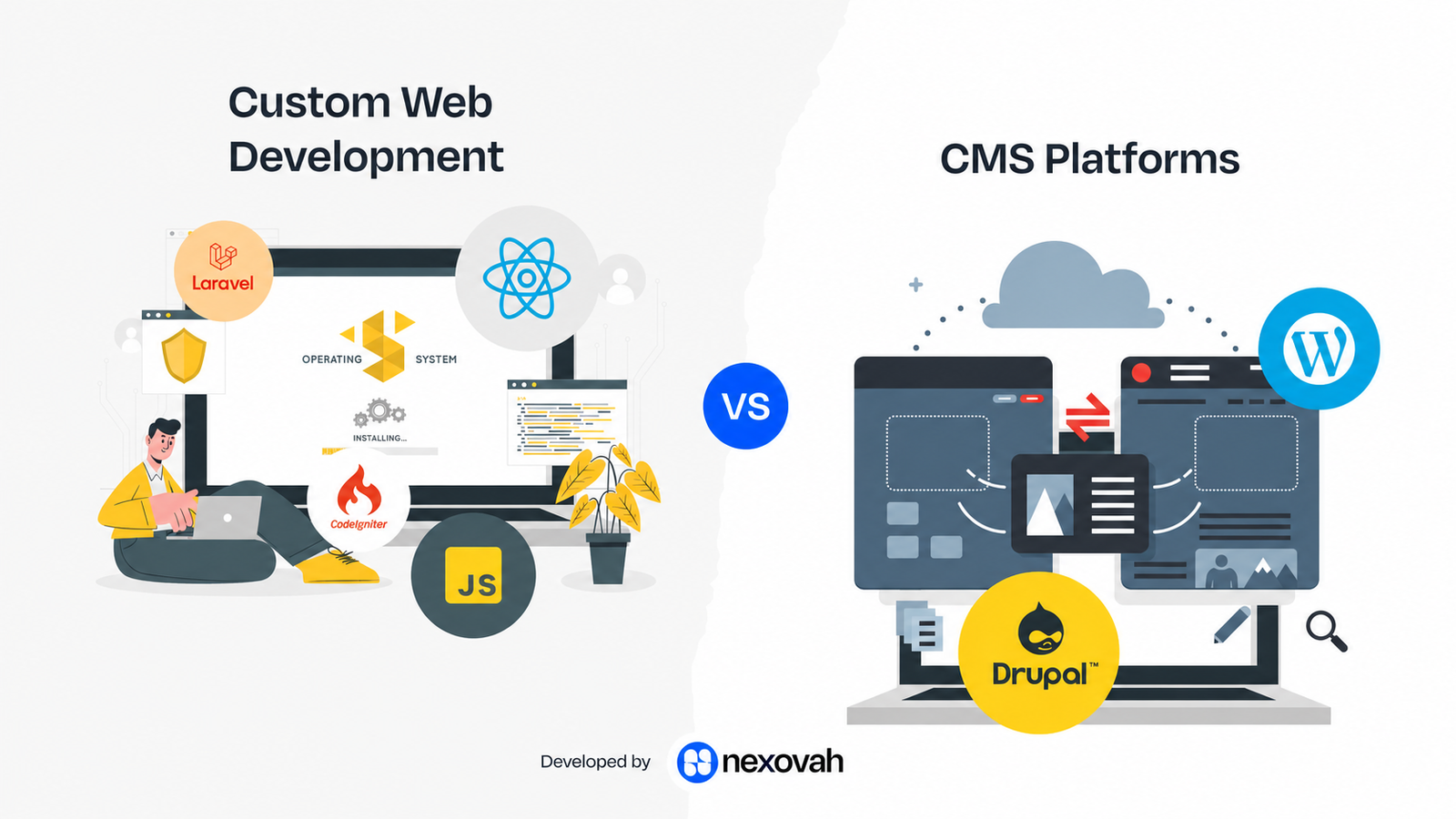
Custom web development and standard CMS platforms solve the same problem — getting a business online — in fundamentally different ways. Neither is universally "better"; the right choice depends on budget, timeline, technical capacity, and how much the site needs to scale.
Flexibility and Customization
Custom development crafts every aspect of a website to specific business requirements — ideal when a business's needs genuinely can't be met by a standard CMS's predefined limitations. Standard CMS platforms, by contrast, work within existing themes and plugin architecture.
Cost and Time Efficiency
Standard CMS platforms like WordPress, Joomla, and Drupal offer quicker deployment and lower upfront costs through pre-built templates and plugins.
Custom web development typically requires a larger initial investment and up to six months of development time depending on complexity — but can offer a higher long-term ROI for businesses with unique, scaling needs.
Security and Performance
Custom-coded websites tend to have stronger security since there's no bloated code or reliance on third-party plugins that need constant updating. Clean, purpose-built code also improves load speed and reduces the surface area for errors — standard CMS platforms carry more inherent risk if plugins aren't kept current.
SEO and Scalability
Custom development is built with SEO optimized from the outset, often producing stronger search positioning. Custom sites are also highly scalable by design — while standard CMS platforms offer scalability too, it's typically more constrained by the platform's underlying architecture.
Technical Expertise Required
Operating a custom-developed website demands more ongoing technical expertise than a standard CMS, which benefits from large support communities and built-in troubleshooting resources.
Quick Comparison
| Factor | Standard CMS | Custom Web Development |
|---|---|---|
| Deployment speed | Fast — pre-built templates | Slower — up to 6 months |
| Upfront cost | Lower | Higher |
| Flexibility | Limited by platform | Unlimited, tailored |
| Security | Depends on plugin upkeep | Stronger by default |
| Best for | Smaller projects, fast launch | Unique, scaling businesses |
Making the Decision
For businesses needing to launch quickly on a limited budget, a standard CMS remains the practical choice. For businesses with unique requirements and a clear growth trajectory, custom web development is the investment that avoids the costly mid-growth rebuild a CMS often forces.
FAQ
A website builder typically bundles free hosting and a domain along with its editor, whereas a standalone CMS does not — CMS software may be free, but overall cost scales with your site's size and functionality.
Published in The Nexovah Blog
Written by Nexovah Staff